
A plate reader trained on one clean national format can fail in its first week on an Indian road. This post sets out the rules that define Indian plates, the variation a reader actually meets, and how we design and test for it.
Key points
- Vehicles manufactured on or after 1 April 2019 must come with a High Security Registration Plate (HSRP) supplied by the manufacturer.
- The BH series, introduced by a notification of 26 August 2021, uses the format YY BH #### XX.
- Battery-operated vehicles carry green plates: yellow characters for transport vehicles, white for all others.
- Older plates, non-standard fonts and hand-painted plates are still common, so a reader must handle all of them.
- Two-wheeler plates are smaller and often two-line, which makes them the hardest everyday case.
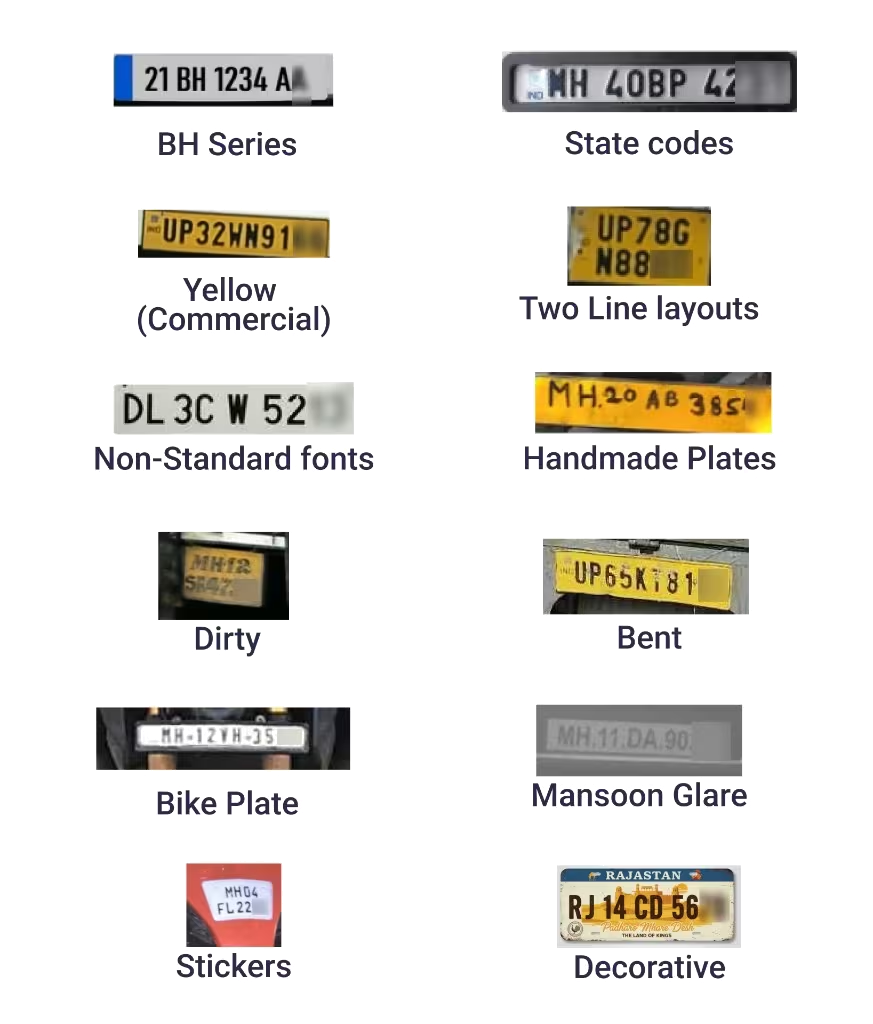
The rules that define a plate
High Security Registration Plates
On 6 December 2018, the Ministry of Road Transport and Highways (MoRTH) announced amendments to the Central Motor Vehicles Rules, 1989. According to the PIB release, the HSRP, including the third registration mark, must be supplied by vehicle manufacturers with vehicles manufactured on or after 1 April 2019. Dealers can also supply HSRPs for older vehicles.
Reporting by Autocar India lists the security features: a chromium-based hologram hot-stamped at the top left of both plates, a 10-digit permanent identification number laser-branded at the bottom left, the word "India" in the hot-stamping film on the characters, at least two non-reusable snap locks on the rear plate, and a third registration mark as a hologram sticker inside the windscreen.
Bharat series (BH)
MoRTH introduced the BH series by a notification dated 26 August 2021. The PIB release gives the format:
YY BH #### XX
YY   = year of first registration
BH   = code for Bharat series
#### = 0000 to 9999 (randomised)
XX   = letters AA to ZZ
For a reader, the BH series changes the grammar. A model or post-processing rule that expects a state code in the first two characters will reject a valid BH plate.
Colour codes
Under G.S.R. 749(E) of 7 August 2018, battery-operated transport vehicles carry yellow characters on a green background, and all other battery-operated vehicles carry white characters on green, as stated in a later PIB release. Private vehicles commonly carry black on white and commercial vehicles black on yellow. A reader that depends on dark characters on a light background fails on green and other dark plates.
What actually appears on the road
| Variation | Why it is hard for a reader |
|---|---|
| HSRP and pre-HSRP plates side by side | Different fonts, spacing and borders in the same hour of traffic |
| Single, double and triple lines | Character order must be rebuilt from two or three rows |
| BH series | Breaks the "state code first" pattern |
| Green, yellow, white and other colours | Polarity and contrast change between plates |
| Hand-painted and non-standard fonts | Character shapes outside any standard |
| Dirt, bends, stickers, decorative frames, tow bars | Parts of characters are hidden or distorted |
| Two-wheeler plates | Smaller plates, often two-line, often partly hidden by the rider or a carrier |
| Monsoon glare, fog, night IR | Contrast and reflection change with weather and illumination |
Regional scripts and mixed markings also appear. Most plates use Latin characters, but evaluation data has to include what the corridor shows, not only standard plates.
Why two-wheelers are the hardest everyday case
Two-wheelers are a large share of Indian traffic, and their plates are small. At the same pixel footprint, a smaller plate gives fewer pixels per character. Many are two-line plates, so each line is even shorter. Riders, pillion passengers and luggage can hide part of the plate, and the vehicle leans and weaves.
Our own published figures show the gap. GateGuard reads above 98% for four-wheelers and above 92% for two-wheelers. We publish these as separate numbers on purpose; our post on measuring ANPR accuracy explains why one blended figure would hide the harder case.
How we design for it
- Train on Indian plates: our ANPR engine is trained on 10M+ Indian plates, including hand-painted, non-standard, partly hidden and colour plates.
- Do not depend on colour or font: the GateGuard engine is colour-independent and font-independent, so a green EV plate and a black-on-white plate go through the same pipeline.
- Read every layout: the Recon Global Shutter Camera supports single-line, double-line and triple-line formats.
- Get more views: a higher frame rate gives more chances to find a clean view. GateGuard runs at 25 FPS for this reason.
- Capture sharply: at highway speed, plate quality starts with the sensor. Our global shutter post works through the blur maths.
The plate types we support on the Lane ANPR page are HSRP, non-HSRP, Bharat series, green (EV), hand-painted and double-line plates. The Recon camera also lists yellow (commercial) and white (private) plates. The VSDS flags plates that do not conform to HSRP standards as a violation type. More on Indian plate challenges is on the Research page.
Frequently asked questions
Are HSRPs mandatory for older vehicles?
The 2018 notification covers vehicles manufactured on or after 1 April 2019. States have set their own deadlines for older vehicles, so check your state transport department.
Can ANPR detect a plate that is not an HSRP?
Yes. The VSDS lists non-HSRP plates, including non-standard formats, as one of its violation types.
Why does the BH series matter for ANPR?
It starts with a year, not a state code. Any validation rule built on the state code pattern must accept BH plates, or valid reads will be thrown away.
Share this article