
This post works through the numbers. It uses one formula for blur, one for skew and one for the number of frames a camera gets of each vehicle. Every input is stated as an assumption so you can repeat the sums for your own site.
Key points
- Blur in pixels = vehicle speed × exposure time ÷ size of one pixel on the plate.
- At 230 km/h a vehicle moves 63.9 mm in 1 ms. Exposure must be well under 1 ms for sharp characters.
- A rolling shutter adds skew on top of blur, because different rows of the plate are captured at different times.
- A global shutter removes skew. Exposure and light still have to be designed together.
- Frame rate decides how many chances the camera gets to read each plate.
Rolling shutter and global shutter
Many CMOS sensors use a rolling shutter. Each row starts and ends its exposure a little later than the row above it. As Teledyne's imaging guide puts it, an object moving fast during rolling shutter acquisition can appear skewed, because the rows are acquired at different times.
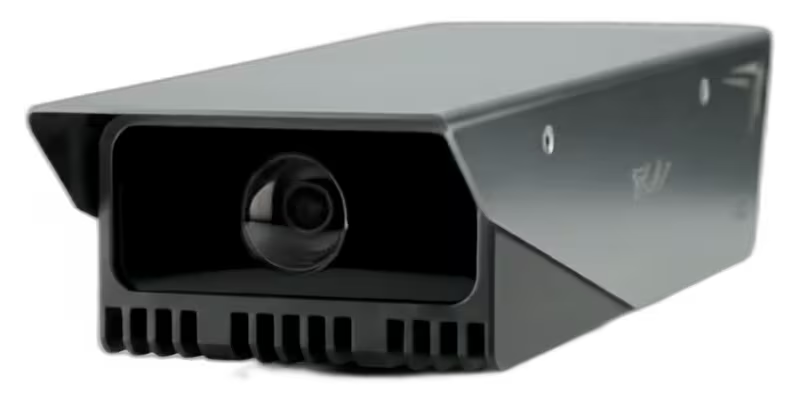
A global shutter sensor exposes all rows at the same moment and then reads them out. Straight edges stay straight. The plate rectangle stays a rectangle. The Recon Global Shutter Camera uses a 2 MP global shutter sensor at 60 FPS.
Motion blur: the formula
speed (m/s)        = speed (km/h) / 3.6
distance moved (mm) = speed (m/s) x exposure (ms)
blur (pixels)       = distance moved (mm) / pixel footprint on the plate (mm/px)
The pixel footprint is the width of road that one pixel covers at the plate. We use these assumptions for the worked example:
- The sensor is 1,920 pixels wide (a typical 2 MP layout).
- The camera frames one lane 3.5 m wide at the capture point, so one pixel covers 3,500 ÷ 1,920 = 1.82 mm.
- All of the vehicle's motion appears in the image. A camera that looks down the lane sees less apparent motion, so these figures are an upper bound.
| Speed | Exposure 1 ms | Exposure 0.2 ms | Exposure 0.1 ms |
|---|---|---|---|
| 100 km/h (27.8 m/s) | 27.8 mm, 15.2 px | 5.6 mm, 3.0 px | 2.8 mm, 1.5 px |
| 230 km/h (63.9 m/s) | 63.9 mm, 35.0 px | 12.8 mm, 7.0 px | 6.4 mm, 3.5 px |
For scale, a plate 500 mm wide (assumption) spans 500 ÷ 1.82 = 275 pixels. A 35-pixel smear across characters a few pixels thick makes them unreadable. At 0.1 ms the smear is about the width of one character stroke.
Rolling shutter skew: a second error
Skew depends on the time between reading the top and bottom rows of the plate, not on exposure. We assume the full 1,080-row frame takes 10 ms to read out, and the plate spans 60 rows.
row time         = 10 ms / 1,080 rows = 0.0093 ms per row
plate read time  = 60 rows x 0.0093 ms = 0.56 ms
skew (mm)        = speed (m/s) x 0.56 ms
skew at 100 km/h = 15.4 mm = 8.5 px
skew at 230 km/h = 35.5 mm = 19.5 px
A global shutter has no row-to-row delay, so this term is zero. The blur term remains and is controlled by exposure. With a rolling shutter you must fight both, and shortening exposure does not remove the skew.
Short exposure needs light
Each tenfold cut in exposure lets in ten times fewer photons. A sharp but dark plate is no better than a bright but smeared one. At night this is the main constraint, so optics, illumination and exposure must be designed together.
The Recon camera has built-in 850 nm IR with a range of up to 40 m, and NightColor for colour imaging in low light. On the VSDS, Pulse IR is used for evidence capture in darkness. Rain, fog and headlight glare change the contrast again, which is why we report accuracy by condition. Our post on measuring ANPR accuracy covers that.
Frame rate: how many chances per vehicle
distance between frames (m) = speed (m/s) / frame rate (FPS)
frames per vehicle = capture zone length (m) / distance between frames| Speed | Distance between frames at 60 FPS | Frames in a 10 m zone (assumption) |
|---|---|---|
| 100 km/h | 0.46 m | about 21 |
| 180 km/h | 0.83 m | about 12 |
| 230 km/h | 1.06 m | about 9 |
More frames give the recogniser more chances to find one sharp, well-lit, unoccluded view of the plate. The same idea applies at gates: GateGuard runs inference at 25 FPS, which gives multiple chances to read each plate.
When a rolling shutter is good enough
A rolling shutter works for slow traffic: parking, gates, footpaths and stop-start junctions. At 20 km/h, skew under our assumptions is about 1.7 pixels. It becomes risky on corridors where traffic runs at 80 to 180 km/h. For speed enforcement, the evidence image must also be tied to one measured vehicle, which our post on radar and camera fusion explains.
The Recon Global Shutter Camera is NATRAX certified for radar-based speed detection up to 230 km/h and vision-based detection up to 180 km/h. See the product page for the full specification, and the Research page for our other briefs.
Frequently asked questions
Does a global shutter remove motion blur?
No. It removes rolling shutter skew. Motion blur depends on exposure time and is the same for both shutter types at the same exposure.
What exposure time do I need?
Pick the largest blur you can accept in pixels, then solve the formula for exposure. Under our assumptions, 3.5 pixels at 230 km/h needs about 0.1 ms.
Why do the figures say "upper bound"?
We assumed all motion appears across the image. A camera that looks along the lane sees part of the motion as the plate growing larger, so real blur is lower.
Share this article